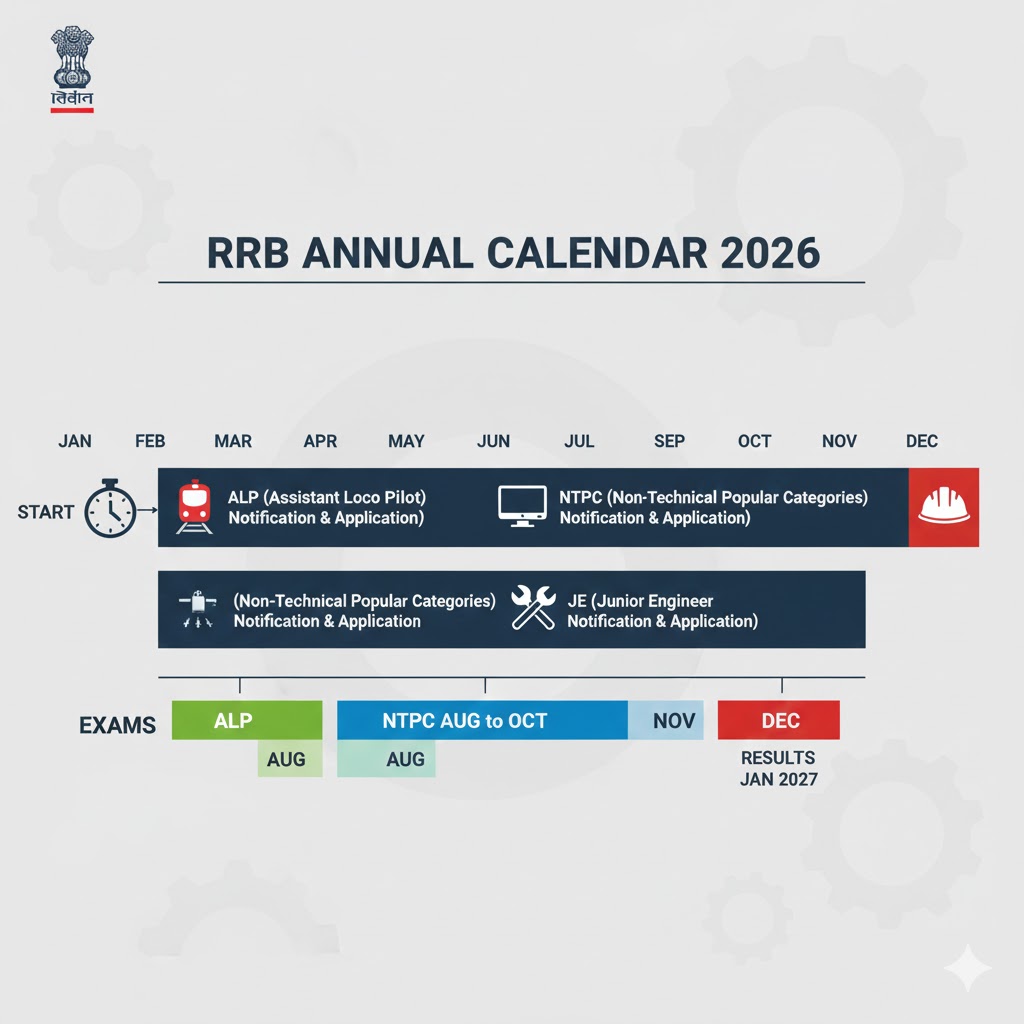
RRB Annual Calendar 2026
The release of the RRB Annual Calendar 2026 marks a monumental shift in the recruitment landscape of the Indian Railways. Moving away from sporadic, large-gap recruitment drives, the Railway Recruitment Boards (RRBs) have institutionalized a fixed, annual notification cycle. This unparalleled level of transparency offers millions of job aspirants the strategic foresight needed to structure their preparation effectively for one of the largest employers in the world.
For candidates aiming for a stable, secure career under the Ministry of Railways, the 2026 calendar is more than just a list of dates—it is a mandatory blueprint for success. This in-depth guide breaks down the tentative annual schedule, details the core exams, and provides a multi-phase preparation strategy to ensure you are ready when the Centralized Employment Notifications (CENs) drop.
1. The Strategic Importance of the RRB Annual Calendar 2026
The decision to publish a pre-defined recruitment calendar for 2026 is rooted in a commitment to streamline the process, reduce candidate anxiety, and ensure the Indian Railways receives a steady influx of skilled manpower.
Why this calendar is a game-changer:
- Predictability: It eliminates the uncertainty that plagued previous cycles, allowing candidates to plan their study timelines over a full year, rather than just a few months.
- Tiered Preparation: With the timelines for major exams like ALP, NTPC, and JE clearly separated, aspirants can adopt a tiered preparation approach, focusing sequentially on technical and non-technical syllabi.
- Transparency in Process: The calendar outlines not just the notification month, but also key internal administrative stages—Vacancy Assessment, OIRMS (Online Indian Railways Management System) updates, and the Proposal for Draft CEN. This provides an unprecedented look into the bureaucratic efficiency driving the recruitment.
The calendar confirms that Indian Railways is maintaining a consistent hiring pace, making the 2026 cycle a golden opportunity for diverse candidates ranging from ITI holders and diploma engineers to general graduates.
2. The Complete RRB Annual Calendar 2026: Tentative Notification Schedule
The official annual calendar segregates the year 2026 into quarterly blocks, dedicating each block to specific categories of recruitment. All dates mentioned below refer to the month in which the draft Centralized Employment Notification (CEN) is proposed to be released.
| Recruitment Period | Recruitment Category (CEN Draft Proposal Month) | Nodal RRB (Management) | Target Educational Qualification |
| January – March | Assistant Loco Pilot (February) | RRB Jammu | ITI, Diploma, Degree (Engineering) |
| Technicians (March) | RRB Thiruvananthapuram | 10+2 (PCM), ITI, Diploma | |
| Section Controller (April) | RRB Mumbai | Graduate Degree | |
| July – September | Junior Engineer (JE) / DMS / CMA (July) | RRB Bhubaneswar | Diploma, Degree (Engineering) |
| Paramedical Categories (July) | RRB Bilaspur | 12th Pass, Relevant Diploma/Degree (Nursing, Pharmacy) | |
| NTPC – Graduate Level (August) | RRB Prayagraj | Graduate Degree | |
| NTPC – Undergraduate Level (August) | RRB Ahmedabad | 12th Pass | |
| October – December | Ministerial & Isolated Categories (September) | RRB Guwahati | Varies (e.g., Degree in Law, Teaching Diploma) |
| Level 1 (Group D) (October) | RRB Chandigarh | 10th Pass / ITI / NAC |
This structured timeline ensures that almost every month of 2026 presents a new major job notification for railway aspirants.
3. Detailed Breakdown of Major RRB Recruitment Categories in 2026
To craft a truly effective preparation strategy, candidates must understand the multi-stage rigor of the major exams scheduled in the rrb annual calender 2026.
A. Assistant Loco Pilot (ALP) and Technicians (Feb/Mar 2026)
This is the gateway for technical candidates (ITI/Diploma/B.Tech). ALP vacancies are critical for the operational safety of the railways.
| Stage | Name | Purpose and Weightage |
| CBT 1 | Screening Test (Common for ALP & Technician) | Minimum qualifying marks; used only for shortlisting for CBT 2 (15 times the vacancy). |
| CBT 2 | Detailed Examination (Part A & Part B) | Part A (Mathematics, Reasoning, General Science, General Awareness) determines merit. Part B (Trade Test/Technical Syllabus) is mandatory qualifying (42% marks). |
| CBAT (for ALP only) | Computer-Based Aptitude Test | Essential for ALP; evaluates sensory and cognitive skills. 70% weightage given to CBT 2 (Part A) and 30% to CBAT for final merit list. |
| DV & Medical | Document Verification and Medical Examination | Final stage; mandatory A1 medical fitness standard for ALP posts. |
B. Non-Technical Popular Categories (NTPC) (August 2026)
The NTPC recruitment, expected in August 2026, caters to both graduate (Levels 4, 5, 6 – Station Master, Goods Train Manager) and undergraduate (Levels 2, 3 – Junior Clerk cum Typist) aspirants.
The Selection Process:
- CBT 1 (Common): Acts as a preliminary screening test. The syllabus is primarily General Awareness, Mathematics, and General Intelligence & Reasoning.
- CBT 2 (Post-Specific): The score from this stage is crucial as it forms the primary basis for the final merit list. It is more in-depth than CBT 1.
- Skill Tests (Post-Dependent):
- Computer-Based Aptitude Test (CBAT): Mandatory for Station Master (SM) and Traffic Assistant. Similar to ALP, this test carries 30% weightage, with CBT 2 carrying the remaining 70%.
- Typing Skill Test (TST): Mandatory for Typist posts (e.g., Junior Clerk cum Typist, Junior Account Assistant cum Typist). This test is qualifying in nature, requiring specific speed in English or Hindi.
C. Junior Engineer (JE) / DMS / CMA (July 2026)
Targeting diploma and degree holders in specific engineering disciplines, the JE notification is slated for July 2026. This is a highly specialized recruitment drive.
The process typically involves:
- CBT 1: Common screening test covering General Awareness, Mathematics, General Intelligence & Reasoning, and General Science.
- CBT 2: Technical knowledge test covering the candidate’s specific engineering discipline along with subjects like Physics, Chemistry, and Basics of Computers/Environment. The merit list is based heavily on the CBT 2 score.
- DV & Medical: Final stages before appointment.
D. Level 1 (Group D) Posts (October 2026)
The Level 1 recruitment, commonly known as Group D, is expected later in the year. It offers a massive number of entry-level positions like Track Maintainer and various Helpers.
The selection process is distinct:
- CBT: A single-stage Computer-Based Test covering General Science, Mathematics, General Intelligence & Reasoning, and General Awareness.
- Physical Efficiency Test (PET): Mandatory qualifying stage where candidates must meet specific standards for running and lifting/carrying weight, ensuring they are physically fit for the demanding nature of the posts.
- DV & Medical: Final verification and medical check-up.
Read Also
4. The Optimized Preparation Strategy: Leveraging the 2026 Timeline
The annual calendar gives you the luxury of time, but success demands a structured, phased approach rather than last-minute cramming.
Phase I: Foundation Building (January – April 2026)
- Focus on Core Common Subjects: Dedicate the initial months to strengthening the common syllabus that appears in every RRB exam: Mathematics, General Intelligence & Reasoning, and General Science (especially Physics and Chemistry up to Class 10/12 level).
- Target ALP/Technician: Since these notifications arrive first (February/March), technical candidates should simultaneously revise their core technical trade subjects (Part B of CBT 2). Use this period to master the foundations of Electrical, Mechanical, or Electronics Engineering as applicable.
- Establish a Mock Test Routine: Start taking subject-specific tests weekly to identify your weak areas and measure your progress.
Phase II: Specialization and Depth (May – August 2026)
- NTPC Focus: As the NTPC notification (August) approaches, shift your General Awareness focus to include Indian History, Polity, Economy, and Current Affairs, which carry a higher weightage in the NTPC CBT 2.
- JE Preparation: Engineering candidates targeting JE should begin intensive preparation for the CBT 2 technical syllabus, which is highly specialized.
- Aptitude Mastery (CBAT): Candidates aiming for Station Master or ALP must begin practicing Computer-Based Aptitude Test (CBAT) batteries. Since CBAT score has a significant 30% weightage in the final merit, neglecting it is a common mistake. CBAT skills require practice and are not purely knowledge-based.
Phase III: Consolidation and Execution (September – December 2026)
- Level 1 Readiness: Candidates for Group D (Level 1) posts must start integrating physical fitness training (PET) with their CBT studies. The PET is a knockout stage and cannot be ignored.
- Typing Skill Practice: If you are targeting Typist posts, dedicated daily practice for the Typing Skill Test (TST) is mandatory. Ensure you can maintain the required speed and accuracy even under pressure.
- Full-Length Mock Tests: Transition from sectional tests to full-length, timed mock tests mimicking the actual exam environment. Analyze your mistakes rigorously. This is the stage for refining time management and accuracy.
5. Emerging Trends and Final Advice for Aspirants
The RRB annual calender 2026 reinforces Indian Railways’ commitment to merit-based recruitment, emphasizing a multi-stage process that rewards consistency.
- Rising Importance of CBT 2: For major posts like ALP and NTPC, the CBT 2 score, combined with the CBAT/TST performance, forms the final merit list. CBT 1 is largely a screening tool. Your preparation must therefore prioritize the depth and higher difficulty level of the CBT 2 syllabus.
- Adherence to Official Notifications: While this annual calendar provides tentative months, candidates must exclusively rely on the official Centralized Employment Notifications (CENs) published on the official regional RRB websites for exact dates, eligibility criteria, and vacancy distribution.
- Mandatory Aadhaar Authentication: Following recent recruitment cycles, Aadhaar-based E-KYC authentication is mandatory, ensuring transparency and eliminating impersonation. Candidates must ensure their Aadhaar details are up-to-date and verified well in advance of the examination dates.
The journey to securing a position in the Indian Railways in 2026 is a marathon, not a sprint. The fixed annual calendar is your map; your dedication is the fuel. By strategically planning your studies, focusing on the higher-stakes stages (CBT 2 and Skill Tests), and maintaining consistency throughout the year, you can convert the predictability of the 2026 schedule into an assured path to success.
You can also check out this video providing a summary and discussion of the RRB Annual Calendar 2026 to complement your reading. RRB Annual Calendar 2026 | RRB NTPC | RRB JE | RRB Group D | RRB ALP