- Why Specialized WordPress Hosting is a Smart Investment
- The Main Types of WordPress Hosting (A Deep Dive)
- Key Features to Compare in a WordPress Hosting Provider
- How Your Choice of WordPress Hosting Impacts SEO
- Common Pitfalls to Avoid When Choosing WordPress Hosting
- Understanding the WordPress Hosting Migration Process
- Frequently Asked Questions (FAQ) about WordPress Hosting
- Your Website Deserves a Good Home
WordPress powers over 39.9% of all websites on the internet. It’s a versatile, powerful, and user-friendly platform. But to make your WordPress website accessible to the world, it needs a “home” on the internet. That home is its web hosting.
However, not all hosting is created equal. Just as you wouldn’t build a high-performance race car and put bicycle tires on it, you shouldn’t run a powerful platform like WordPress on generic, unoptimized hosting. This is where WordPress hosting enters the picture.
This comprehensive guide will walk you through every aspect of WordPress hosting. We’ll explore what it is, why it’s different, the types available, what to look for, and how to choose the perfect solution for your website, whether you’re a hobby blogger or a large e-commerce enterprise.
Why Specialized WordPress Hosting is a Smart Investment
At first glance, “WordPress hosting” might seem like a marketing term. After all, WordPress is a PHP-based application, and any hosting that supports PHP and MySQL can technically run it. However, true WordPress hosting is a specialized service built from the ground up to optimize the performance, security, and management of WordPress sites.
Choosing specialized WordPress hosting over generic hosting is one of- the most significant decisions you can make for your website’s success. Here’s why it’s a critical investment.
H3: The Performance Edge of WordPress Hosting
Speed is everything. A 1-second delay in page load time can lead to a 7% reduction in conversions. WordPress, with its ecosystem of plugins, themes, and dynamic content, can become slow if not run in an optimized environment.
Specialized WordPress hosting tackles this with:
- Optimized Server Stacks: These hosts don’t use a one-size-fits-all server setup. They use the best-in-class software like NGINX (a high-performance web server), the latest versions of PHP, and custom-configured MySQL databases that are all fine-tuned to work seamlessly with WordPress.
- Built-in Caching: High-quality WordPress hosts provide server-level caching. This is vastly superior to plugin-based caching because it stores your site’s data before WordPress even gets involved. This means pages are served to visitors almost instantly, dramatically improving your site speed and Core Web Vitals scores.
- Content Delivery Network (CDN) Integration: Many WordPress hosts include a CDN service. A CDN stores copies of your website (like images and static files) on servers around the world. When a visitor from Japan accesses your site (hosted in the US), the CDN serves them content from a local server in Asia, making load times lightning-fast no matter where your audience is.
H3: Advanced Security for Your WordPress Hosting Environment
As the world’s most popular CMS, WordPress is also the most-targeted platform by hackers. Generic hosting providers put the burden of security almost entirely on you. Specialized WordPress hosting, however, takes a proactive, multi-layered approach.
- WordPress-Specific Firewalls (WAFs): These are firewalls designed to block threats that specifically target WordPress vulnerabilities, such as brute-force login attempts, SQL injections, and cross-site scripting (XSS).
- Proactive Malware Scanning: These hosts don’t wait for you to report a problem. They actively scan your site’s files for malware and, in many cases, will remove it for you automatically.
- Automatic Updates: One of the top- entry points for hackers is an outdated plugin or theme. Managed WordPress hosting providers often handle these updates for you, testing them in a safe environment before applying them to your live site.
- Free SSL Certificates: Every reputable host now offers free Let’s Encrypt SSL certificates, which are crucial for security (enabling
https://) and are a known Google ranking factor.
H3: The Value of Expert WordPress Hosting Support
This is perhaps the most underrated, yet most valuable, feature. With generic hosting, if your site goes down, you’ll call support, and they’ll tell you “the server is online,” leaving you to figure out the rest.
With expert WordPress hosting support, the team is composed of WordPress specialists. You’re not just talking to a server admin; you’re talking to someone who understands wp-config.php, can identify a problematic plugin, and can help you troubleshoot the “white screen of death.” This level of support can save you hours of panic and thousands of dollars in developer fees.
The Main Types of WordPress Hosting (A Deep Dive)
“WordPress hosting” isn’t a single product. It’s an umbrella term that covers several different types of hosting services, each with its own pros, cons, and ideal user.
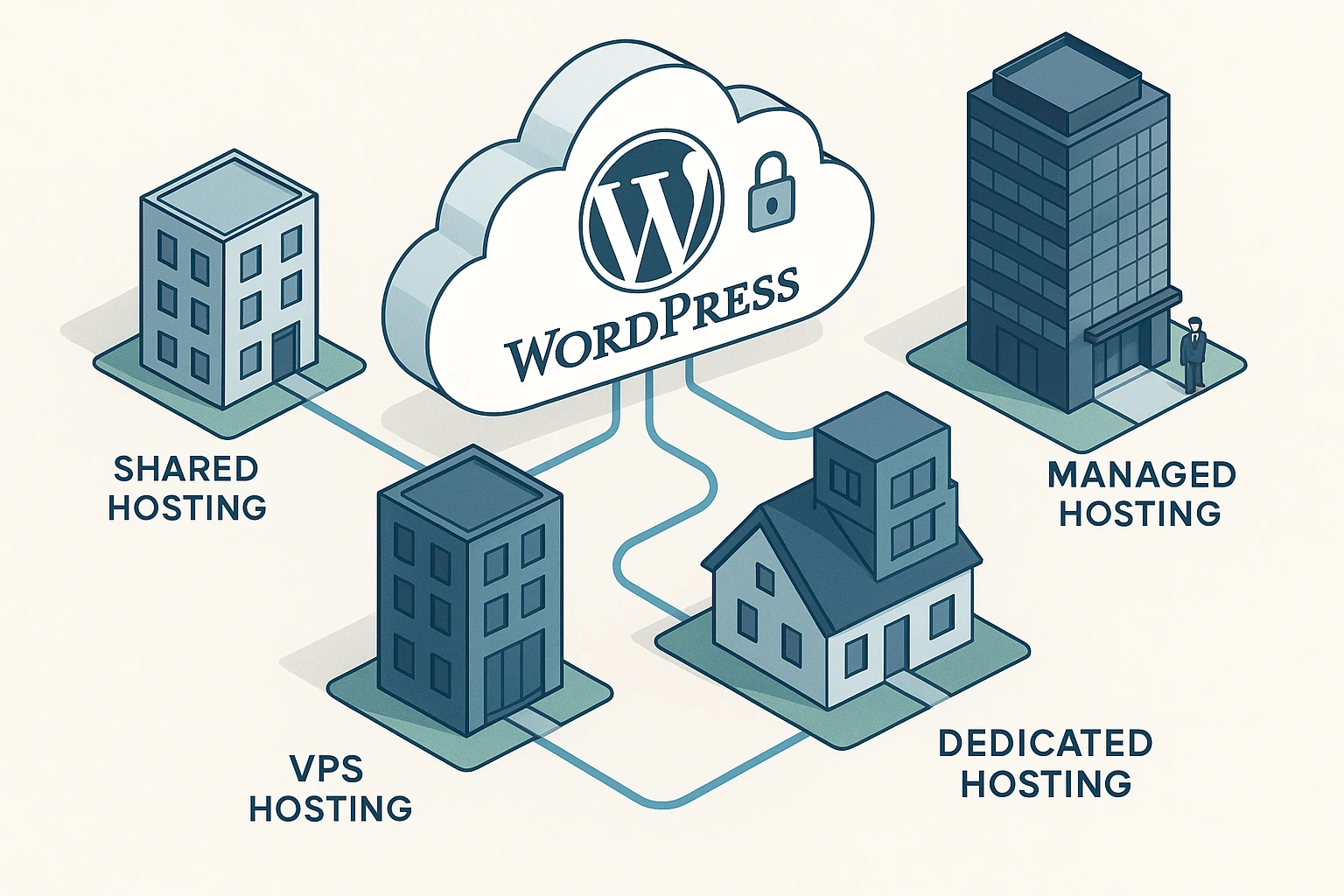
H3: Shared WordPress Hosting: The Starter Pack
Shared WordPress hosting is the most common and affordable option.
- What It Is: Your website “shares” a single physical server with hundreds, or even thousands, of other websites. All sites on the server share its resources: CPU, RAM, and disk space.
- The Analogy: It’s like living in an apartment building. You get your own apartment (your hosting space), but you share the building’s main utilities, elevator, and plumbing (the server resources).
- Pros:
- Extremely Affordable: Often just a few dollars a month.
- Beginner-Friendly: Usually comes with a simple control panel (like cPanel) and one-click WordPress installation.
- Low Maintenance: The hosting company handles all server maintenance.
- Cons:
- “Noisy Neighbor” Effect: If another website on your shared server suddenly gets a massive traffic spike or is under a DDoS attack, it can slow down your website.
- Limited Resources: You have a strict cap on resources, and performance can suffer as your site grows.
- Security Risks: While hosts try to isolate accounts, a vulnerability on one site can potentially create a risk for others on the same server.
- Who It’s For: Brand new bloggers, hobbyists, and small personal websites with low traffic.
H3: VPS WordPress Hosting: The Scalable Step-Up
VPS stands for Virtual Private Server. This is the logical next step up from shared hosting.
- What It Is: A single physical server is still shared, but it’s partitioned into a few powerful, virtual servers. Each virtual server is isolated and has its own guaranteed set of resources (CPU and RAM).
- The Analogy: It’s like owning a condo. You’re still in a shared building, but you have your own dedicated, walled-off space with your own plumbing and electrical system. What your neighbors do doesn’t directly affect your unit.
- Pros:
- Guaranteed Resources: Your site’s performance isn’t affected by “noisy neighbors.”
- More Control: You often get “root” access, allowing you to install custom software and configure the server to your exact needs.
- Scalable: You can easily add more RAM or CPU as your traffic grows without migrating to a new server.
- Cons:
- More Expensive: Costs are higher than shared hosting.
- Requires Technical Skill: With an “unmanaged” VPS, you are responsible for all server maintenance, security, and updates. This is not for beginners.
- Who It’s For: Tech-savvy site owners, small businesses, and growing websites that have outgrown shared hosting. (Note: “Managed VPS” options exist that combine the power of a VPS with the convenience of managed hosting).
H3: Dedicated WordPress Hosting: The Powerhouse
This is the top-tier of traditional hosting, offering maximum power and control.
- What It Is: You rent an entire physical server exclusively for your website. All of its resources are 100% yours.
- The Analogy: It’s like owning a house. You have complete control, total privacy, and all the space is yours. You’re also responsible for all the maintenance (unless you pay for a “managed” service).
- Pros:
- Maximum Performance: No one else is using your resources. This is as fast as it gets.
- Total Control: You can customize the hardware, operating system, and all server software.
- Highest Security: Your site is completely isolated, eliminating risks from other tenants.
- Cons:
- Very Expensive: This is the priciest option, often costing hundreds of dollars per month.
- Extreme Technical Responsibility: You need to be a system administrator to manage a dedicated server.
- Who It’s For: High-traffic e-commerce stores, large corporations, and websites with massive resource needs and strict security requirements.
H3: Managed WordPress Hosting: The White-Glove Service
This is the most popular and recommended option for serious businesses and bloggers. “Managed” is a service level, not a server type. You can have managed shared, managed VPS, or managed dedicated hosting.
- What It Is: A hosting provider takes care of all the technical aspects of running your WordPress site. This goes far beyond just server maintenance.
- The Analogy: It’s like living in a luxury, full-service hotel. You get a beautiful room (your hosting), and a dedicated team handles cleaning (updates), security (malware removal), and concierge (expert support).
- Pros:
- Hassle-Free: Automatic updates, automatic daily backups, and proactive security are all done for you.
- Staging Environments: Easily create a “staging” copy of your site to test new plugins or design changes without breaking your live site.
- Expert Support: You get access to true WordPress specialists, as mentioned earlier.
- Blazing Speed: These platforms are built on high-performance architecture (often cloud or VPS) and include server-level caching by default.
- Cons:
- More Expensive: You are paying for a premium, time-saving service.
- Restrictive: To ensure performance and security, many managed hosts “disallow” certain plugins (like caching plugins, which are redundant) that can cause problems.
- Who It’s For: Small businesses, serious bloggers, e-commerce stores, agencies, and anyone who values their time and wants their site to be fast, secure, and reliable without the technical headache.
H3: Cloud WordPress Hosting: The Flexible Frontier
This is a newer, highly scalable, and reliable type of hosting.
- What It Is: Instead of your site living on one single server, it lives on a vast, distributed network of servers (the “cloud”).
- The Analogy: It’s like a an infinitely scalable utility. You plug into the grid, and you get as much power as you need. If one power plant goes down (one server fails), the grid automatically reroutes power from another, so you never experience an outage.
- Pros:
- Superior Reliability: If one server in the network fails, your site is automatically moved to another. This results in near-perfect uptime.
- Effortless Scalability: If your site suddenly goes viral, the cloud network can instantly assign more resources to handle the traffic spike.
- Pay-as-you-go: Often, you only pay for the resources you actually use.
- Cons:
- Pricing Can Be Complex: The pay-as-you-go model can be confusing and unpredictable compared to a fixed monthly fee.
- Who It’s For: High-growth startups, e-commerce stores with big sales (like Black Friday), and anyone who needs ultimate scalability and reliability.
Key Features to Compare in a WordPress Hosting Provider
When you’re shopping for a host, it’s easy to get lost in marketing buzzwords. Here are the core features you should actually compare.
H3: Uptime Guarantees and WordPress Hosting Reliability
Look for a host that offers a 99.9% uptime guarantee or higher. Anything less is unacceptable. This guarantee means your site should not be down for more than 43 minutes per month. Good hosts will credit your account if they fail to meet this.
H3: Speed, SSDs, and Server Tech in WordPress Hosting
Don’t just look for “unlimited” space. Look for quality space.
- SSD vs. HDD: Ensure your host uses SSD (Solid State Drives). They are dramatically faster than old-school HDD (Hard Disk Drives) and make a huge difference in your site’s database and file access speeds.
- PHP Version: Your host should support the latest stable version of PHP (the language WordPress is built on).
- Server Location: If your audience is primarily in one country, choosing a host with data centers in or near that country can improve load times.
H3: Automatic Backups: Your WordPress Hosting Safety Net
A website without backups is a disaster waiting to happen. Do not ever rely on a plugin as your only backup solution. Your host should provide:
- Automatic, daily backups.
- Off-site storage (backups shouldn’t be on the same server as your site).
- A one-click restore feature so you can roll back your site instantly if something goes wrong.
H3: Staging Environments: A Non-Negotiable for WordPress Hosting
A staging site is a private, one-click copy of your live website. Why do you need it?
- Test a new plugin without fear of it crashing your site.
- Redesign your homepage and get feedback before pushing it live.
- Troubleshoot errors without your visitors seeing a broken page.This feature is a hallmark of high-quality managed WordPress hosting and is an absolute game-changer.
H3: Scalability: How Your WordPress Hosting Grows With You
Your hosting choice today shouldn’t limit your success tomorrow. Ask potential providers:
- “What happens when I outgrow my current plan?”
- “How easy is it to upgrade?”
- “Will there be downtime during the upgrade?”A good host will have a clear, seamless upgrade path, allowing you to move from shared to VPS to cloud as your traffic increases.
How Your Choice of WordPress Hosting Impacts SEO
Many people don’t realize that their hosting provider is a critical part of their Search Engine Optimization (SEO) strategy. Google wants to provide its users with fast, secure, and reliable results. Your host directly impacts all three.
H3: Site Speed and Core Web Vitals from Your Hosting
Google has been explicit: site speed is a ranking factor. Since 2021, this has been measured by Core Web Vitals (CWV), which include metrics for loading speed, interactivity, and visual stability. A slow host (like a cheap shared server) will make it nearly impossible to get good CWV scores, no matter how much you optimize your images or plugins. A fast WordPress host with server-level caching gives you a massive head start.
H3: Uptime, Crawlability, and Your WordPress Hosting
If your website is frequently down, search engine crawlers (like Googlebot) will eventually stop visiting. If they can’t access your site, they can’t index your new content, and your existing rankings will plummet. That 99.9% uptime guarantee isn’t just for users; it’s for search engines, too.
H3: Security, SSL, and Trust Signals from Your Hosting
Google has also confirmed that HTTPS is a ranking signal. An SSL certificate (which enables https://) encrypts the connection between your site and your visitors, protecting their data. Reputable WordPress hosts provide free, auto-renewing SSL certificates. Furthermore, if your site gets hacked and starts serving malware, Google will blacklist it, showing a “This site may be harmful” warning to all visitors and instantly destroying your traffic and rankings. Good, secure hosting is your first line of defense.
Common Pitfalls to Avoid When Choosing WordPress Hosting
It’s easy to make a mistake. Here are the most common traps to avoid.
H3: The “Unlimited” WordPress Hosting Myth
When you see “unlimited storage” or “unlimited bandwidth,” be skeptical. It’s a marketing gimmick. Read the fine print. You’ll find a “fair use policy” that states if your site uses too many resources (impacting other users on a shared server), they will throttle your site or force you to upgrade. A host that is transparent about your limits (e.g., “100,000 visits, 20GB storage”) is actually more trustworthy.
H3: Ignoring High Renewal Prices for Hosting
This is the oldest trick in the book. A host advertises a plan for $2.95/month, and you sign up for three years. What you miss is that the renewal price is $12.95/month. Always, always check the renewal rate before you buy. A great introductory deal is fine, but make sure the long-term cost is sustainable for you.
H3: Choosing a WordPress Hosting Provider on Price Alone
You get what you pay for. That $1/month host is cutting corners somewhere. It could be in performance (slow, old servers), security (no firewalls, no malware scanning), or support (outsourced, untrained staff). Your website is your digital storefront, your portfolio, or your passion project. Investing a few extra dollars a month for a reliable, fast, and secure host is one of the best investments you can make.
Understanding the WordPress Hosting Migration Process
What if you’re already with a bad host? The good news is, you can move.
H3: Free vs. DIY WordPress Hosting Migration
Many new hosts, especially managed WordPress hosts, want to make switching as painless as possible. They will offer free, professional site migrations. A team of experts will securely copy your entire website—files, database, plugins, and all—to your new hosting account with minimal to zero downtime.
If your new host doesn’t offer this, you can do it yourself with plugins like All-in-One WP Migration or Duplicator. However, for a mission-critical site, letting the professionals at your new host handle it is always the safest bet.
Frequently Asked Questions (FAQ) about WordPress Hosting
Q: What is the best WordPress hosting?
A: There is no single “best” host. The best host for you depends on your needs.
- For beginners: A good, reputable Shared WordPress Host (like Bluehost or SiteGround) is a great start.
- For businesses: A Managed WordPress Host (like Kinsta, WP Engine, or Flywheel) is highly recommended for its performance, security, and support.
- For high traffic: A Cloud or VPS WordPress Host offers the best scalability and performance.
Q: How much does WordPress hosting cost?
A: Prices vary widely.
- Shared: $3 – $15 per month.
- Managed: $25 – $150 per month.
- VPS: $20 – $100 per month.
- Dedicated: $100 – $500+ per month.
Q: Do I need WordPress hosting to use WordPress? (WordPress.com vs. WordPress.org)
A: This is a key distinction.
- WordPress.com is a hosted platform where the hosting is included. It’s simpler but much more restrictive (you can’t install all plugins or themes on lower plans).
- WordPress.org is the free, open-source software you download. To use it, you must buy your own web hosting. This article is about hosting for WordPress.org, which gives you 100% control and flexibility.
Q: What is “Managed” WordPress hosting?
A: It’s a premium, “white-glove” service where the hosting provider handles all the technical management of your WordPress site. This includes automatic core and plugin updates, daily backups, staging sites, and proactive security monitoring, all backed by expert WordPress support.
Q: Can I use any web host for WordPress?
A: Yes, you can technically use any host that supports PHP and MySQL. However, you will miss out on the performance optimizations, security features, and expert support that come with a specialized WordPress hosting plan.
Q: How does WordPress hosting affect my site’s speed?
A: Massively. A good host uses fast servers (SSDs), server-level caching, a CDN, and the latest versions of PHP. All of these factors combine to serve your pages to visitors much faster than a generic, non-optimized host.
Q: What is a CDN and do I need one with my hosting?
A: A CDN (Content Delivery Network) stores copies of your site’s static assets (images, CSS, JS files) on servers around the globe. It serves content to visitors from the server geographically closest to them, dramatically speeding up your site for a global audience. Many high-quality WordPress hosts now include a CDN for free.
Your Website Deserves a Good Home
Choosing your WordPress hosting is one of the most foundational decisions you will make for your online presence. It’s the digital equivalent of choosing the location for a physical store.
While it can be tempting to choose the cheapest option available, this decision can cost you in the long run through lost visitors, poor search engine rankings, and massive security headaches.
By investing in quality hosting that matches your needs—whether it’s an affordable shared plan, a powerful dedicated server, or a time-saving managed plan—you are setting your website up for success. You’re ensuring it’s fast, secure, and always online for the visitors and customers who need it.


Pingback: The Ultimate Guide to Life Insurance in India 2025